Some neighborhoods exist simply as administrative units on a city map, and some neighborhoods live, breathe, and think. Nunoa belongs to the second category. Located in the heart of Greater Santiago, this municipality of just over 160,000 inhabitants has built, over decades, an identity so recognizable that its name alone conjures precise images: jazz nights in bars along Irarrazaval, writers’ gatherings in old colonial houses, families strolling through Plaza Nunoa on Sunday afternoons, bustling markets filled with fruit and conversation, and an architecture that refuses to surrender to modernity without putting up a fight.
Nunoa is, in many respects, the cultural conscience of Santiago. It is the neighborhood where politics is debated at cafe tables, where artists rent studios in quiet alleyways, where university students mingle with elderly residents who remember the neighborhood as it was fifty years ago. This generational and ideological coexistence, far from generating conflict, has produced an extraordinarily rich social fabric, making Nunoa a singular place within the Chilean metropolitan context.
1. Origins and History: From Indigenous Peoples to the Modern City
The territory that today makes up Nunoa has a history that long predates the arrival of the Spanish. In pre-Columbian times, these lands were part of the territories inhabited by Mapuche-Picunche communities, who took advantage of the fertile soils irrigated by the Mapocho River and its tributaries to establish agricultural settlements. The very name Nunoa comes from Mapudungun and evokes, according to different interpretations, the idea of a green place or a particular plant that grew in the area.
During the colonial period, the area functioned as a peripheral farm on the outskirts of the city of Santiago, which Pedro de Valdivia founded in 1541 a few kilometers to the west. The lands of what is now Nunoa were distributed among conquistadors and religious orders, who established haciendas and vineyards. For centuries, the area was characterized by its agricultural vocation, serving as a food supplier for the capital city.
The formal constitution of Nunoa as a municipality dates from the nineteenth century. After Chilean independence, the process of territorial organization was gradual, and in 1891, with the enactment of the Autonomous Municipality Law, Nunoa acquired its own municipal status. This administrative milestone coincided with a period of urban expansion in Santiago: the city was growing eastward, and middle and upper classes were beginning to seek quieter and healthier living conditions in areas away from the historic center.
The twentieth century was the period of greatest transformation for Nunoa. During its first decades, the neighborhood attracted middle-class families linked to education, the arts, and the state bureaucracy. Neoclassical and art deco residences were built, many of which can still be admired on certain streets today. The arrival of trams and, later, the metro consolidated the neighborhood’s connection with the rest of the city and accelerated its densification.
2. Geography and Territory: A Neighborhood Between the Center and the East
Nunoa covers an area of approximately 17 square kilometers, making it one of the smallest but most densely populated neighborhoods in the Metropolitan Region. It borders Providencia to the north, La Reina and Macul to the east, San Joaquin and La Granja to the south, and central Santiago to the west. This strategic location — placing it as a transition zone between historic Santiago and the more modern neighborhoods of the eastern sector — partly explains its particular character.
The terrain of Nunoa is predominantly flat, with a slight westward incline characteristic of the Andean piedmont. This topographic condition has historically favored urban development, although it has also generated drainage problems during periods of heavy rainfall. The climate is semi-arid Mediterranean, with warm dry summers and cool rainy winters, similar to the rest of the Santiago basin.
Within the urban fabric of Nunoa, several neighborhoods with distinct personalities can be identified. The area around Plaza Nunoa serves as the social and commercial heart of the commune. Barrio Italia, which it shares partly with Providencia, has in recent years become one of the most dynamic focuses of urban culture in Santiago. The sectors along Irarrazaval Avenue concentrate vibrant commercial activity. And the residential neighborhoods to the east, with their houses from the 1940s and 1950s, maintain a tranquility that many Santiaguinos envy.
3. Cultural Identity: A City Within the City
If there is one trait that defines Nunoa above all others, it is its cultural vocation. This is not a recent feature nor one artificially constructed for tourist consumption: it has deep historical roots reaching back to the first half of the twentieth century, when the neighborhood began attracting intellectuals, artists, and professionals seeking an environment conducive to thought and creativity.
Nunoa’s political tradition is also an inseparable part of its identity. The neighborhood has historically been a bastion of Chile’s left and progressive movements. During the years of the Popular Unity government (1970-1973), Nunoa was one of the territories where Salvador Allende’s project found the greatest support. The 1973 coup d’etat left deep marks on the neighborhood, with numerous residents directly affected by the repression that followed. This history of political commitment has shaped a civic culture that values participation, debate, and memory.
Nunoa is also a university neighborhood. The presence of the University of Chile, with several of its faculties located within or on the borders of the commune, has guaranteed a constant flow of students, academics, and ideas for decades. This permeable academia, which overflows campus boundaries and settles in the neighborhood’s cafes and bars, has been a fundamental engine of local intellectual life.
In the realm of the arts, Nunoa boasts a remarkable cultural infrastructure. The Municipal Theater of Nunoa, numerous neighborhood cultural centers, independent art galleries, and experimental theater spaces make the commune a place where cultural offerings far exceed what might be expected from a city of its size. Jazz festivals, book fairs, film series, and contemporary art exhibitions follow one another throughout the year, turning each season into an opportunity for gathering and aesthetic experience.
4. Plaza Nunoa: The Heart and Symbol of the Neighborhood
Any description of Nunoa that aspires to be complete must linger on its main square. Plaza Nunoa is not merely a physical space: it is a social institution, a generational meeting point, and the stage on which collective life in the neighborhood is performed every day. With its century-old trees, its benches occupied by retirees playing chess, its corners where young people rehearse on guitar, and its restaurant terraces buzzing with conversation on weekends, the plaza synthesizes the Nunoino character better than any other place.
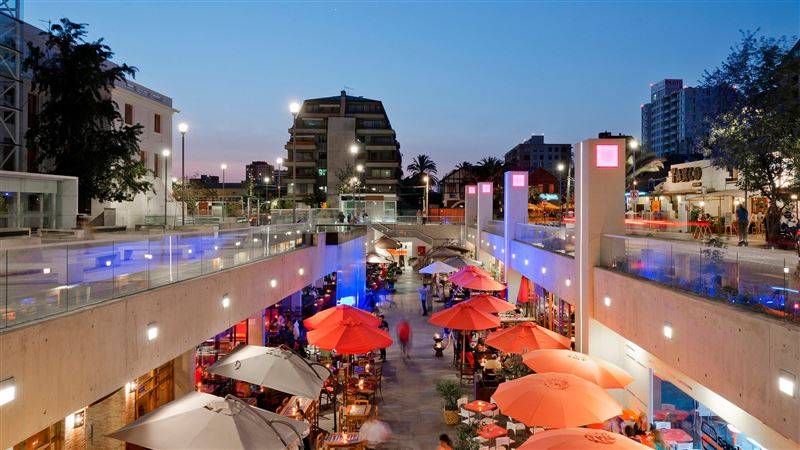
The surroundings of the plaza concentrate much of the commune’s gastronomic and entertainment offerings. Chilean and international restaurants, bars with live music, artisan ice cream shops, neighborhood bakeries, and record stores coexist within a few blocks, creating an atmosphere that blends the bohemian with the family-friendly, the sophisticated with the popular. This balance — difficult to achieve and easy to lose — is one of the most treasured aspects of local identity.
The Church of Our Lady of Carmen, which dominates one side of the plaza, is one of the most representative buildings of Nunoa’s architectural heritage. Its silent presence facing the daily bustle of the square seems to evoke the long history of the commune, reminding visitors that this space has been a meeting point for its residents for generations.
5. Barrio Italia: Creativity in Expansion
On the border between Nunoa and Providencia, the so-called Barrio Italia has undergone a transformation over the past fifteen years that has become a reference point for Chilean urban planning. What was once a sector of old houses belonging to Italian immigrants, craft workshops, and small repair shops has reinvented itself as one of Santiago’s most interesting creative hubs — without entirely losing its character as an authentic neighborhood.
In Barrio Italia, antique dealers maintaining shops full of last century’s furniture coexist with young designers displaying their collections in minimalist boutiques. Specialty coffee shops share a block with family hardware stores. Architecture and design studios occupy restored houses that retain their original facades. This coexistence of old and new, of the established and the emerging, is precisely what makes Barrio Italia irresistible to both Santiaguinos and foreign visitors.
The success of Barrio Italia has also generated tensions. Rising land values and rents have displaced many of the original residents and merchants who gave it its initial character. The debate over gentrification, which affects similar neighborhoods around the world, is felt here with particular intensity. The question of how to preserve a neighborhood’s identity while it transforms is one of the most complex challenges facing urban management in Nunoa.
6. Architectural Heritage: Memory Written in Facades
One of Nunoa’s most striking characteristics is the survival of a remarkable architectural heritage. Unlike other Santiago neighborhoods that have experienced massive demolition and high-rise construction, Nunoa preserves a significant percentage of its historic residential stock. Houses from the 1930s, 1940s, and 1950s, with their front gardens, wrought-iron fences, and adobe or masonry volumes, punctuate the urban landscape with a presence that recalls other eras.
The styles that predominate in this residential architecture are varied: from Spanish neo-colonial to 1940s art deco, passing through postwar rationalist modernism. This stylistic diversity reflects the different moments of the commune’s growth and the changing tastes of its residents over time. Today, many of these houses have been converted into restaurants, galleries, clinics, or cultural organizations, finding new uses that allow them to survive.
Real estate pressure, however, constantly threatens this heritage. Nunoa’s land is coveted by the high-rise construction market, and the demolition of old houses to build apartment towers has been a constant over recent decades. Neighborhood organizations and heritage defense groups permanently fight to protect properties with historical or architectural value, with mixed results. The tension between the right to a dense city and the preservation of built memory is far from resolved.
7. Everyday Life and Community: What Makes the Ordinary Special
Beyond its cultural attractions and heritage value, Nunoa is, fundamentally, a place where people live. And everyday life in the commune has a particular texture that its residents deeply value. The neighborhood markets, where vegetable sellers know their regular customers by name; the bakeries open from dawn; the newspaper stands where current events are still discussed; the parks where children play while their parents chat — all of this composes a neighborhood life that is increasingly scarce in major Latin American cities.
Civic participation is another distinctive trait of Nunoa. The commune has an active network of neighborhood associations, functional organizations, and organized citizen groups that participate in decisions affecting their environment. This culture of participation, which has historical roots in the political traditions of the Chilean left, has generated a particularly vigilant and active citizenship in matters of urban planning, the environment, and culture.
The socioeconomic diversity of Nunoa is also an element that contributes to its vitality. Although recent trends point toward homogenization into middle and upper-middle income groups, the commune still harbors a notable heterogeneity of social groups, which enriches the daily experience and keeps social dynamics alive.
8. Sport and Public Space: The National Stadium and the Parks
Nunoa is home to one of Chile’s most iconic and historically charged sports venues: the Estadio Nacional Julio Martinez Pradanos. Inaugurated in 1938 for the South American Games, the stadium has been the scene of Chile’s greatest sporting moments, including the 1962 FIFA World Cup, in which Chile finished third. Its name is also inscribed in the country’s dark history: during Pinochet’s military dictatorship, the venue was used as a detention and torture center, and efforts to keep that memory alive have turned the stadium into a site of national conscience.
Adjacent to the National Stadium stands the velodrome and the complex of sports facilities that form Santiago’s most important sporting park. The Parque Victor Jara, which honors the memory of the singer-songwriter and academic killed during the coup, also offers outdoor recreational spaces for residents of the area.
Beyond the National Stadium, Nunoa has a network of squares and green areas that structure neighborhood life. The tree-lined main avenues — with oriental plane trees and other large-canopy species — are one of the most characteristic images of the commune in autumn, when leaves paint the sidewalks and parks in ochres and yellows.
9. Gastronomy: A Table That Reflects Diversity
Nunoa’s gastronomic scene is one of its most celebrated assets. The range of restaurants, cafes, and bars is wide, varied, and of remarkable quality, spanning from traditional Chilean cooking to the most innovative fusion proposals. The Irarrazaval corridor concentrates a quantity and diversity of establishments that make it one of Santiago’s leading gastronomic avenues.
The tradition of Nunoa’s bars deserves special mention. Unlike the large entertainment formats that dominate other parts of Santiago, Nunoa’s bars tend toward an intimate format: small venues with good live music, carefully selected domestic wine lists, and an atmosphere that invites conversation. Jazz, blues, and Latin American music find their natural home in Santiago within these spaces.
Neighborhood markets also form an essential part of Nunoa’s gastronomic landscape. The Mercado de Nunoa and the various weekly street fairs that set up throughout the commune offer fresh seasonal produce, direct contact between producers and consumers, and that traditional market atmosphere that large supermarket chains have never quite managed to replace.
10. Nunoa Today: Between Preservation and Change
The Nunoa of the twenty-first century is a commune in permanent tension between its historical identity and the forces of change. Real estate pressure, gentrification, cultural tourism, and urban densification processes pose complex challenges to a community that deeply values what it has built over decades.
At the same time, Nunoa demonstrates a remarkable capacity for adaptation. The new residents — young professionals, artists, entrepreneurs — who come to the commune do so precisely because they are attracted by its character and values, and in many cases become active defenders of the very identity that seduced them. The question is not whether Nunoa will change — all cities change — but whether that change can preserve what is essential: the human scale, the social mix, the culture of encounter in public space.
In that tension, Nunoa remains a fascinating urban laboratory. A commune that does not passively accept what the city wants to make of it, but negotiates, debates, and proposes. A community that has chosen, consciously or intuitively, to build an urban way of life in which culture, coexistence, and history are values as important as efficiency or profitability.
Perhaps that is the most Nunoino quality of all: the conviction that a city can and must be more than a collection of buildings, transactions, and commutes. That it can be a place where people know one another, where ideas circulate, where the past is respected and the future is imagined together. In that sense, Nunoa is not merely a neighborhood of Santiago. It is a proposal for how we want to live together.