Chile is one of South America’s most rewarding road trip destinations — a country where the highway takes you from the world’s driest desert to ancient Patagonian glaciers in a single, sweeping journey. But before you grip the steering wheel and pull out of the rental lot, a practical question deserves an honest answer: is it actually safe to drive in Chile as a tourist? The short answer is yes — with caveats. Chile’s roads are among the best maintained in Latin America, its drivers are relatively orderly compared to regional neighbors, and its traffic laws are clear and enforceable. But like any unfamiliar country, Chile has its own driving culture, road conditions, and legal quirks that every foreign driver must understand before hitting the road.
Chile’s Overall Road Safety Profile
By Latin American standards, Chile is a safe country to drive in. Reddit travelers and experienced road-trippers consistently report that driving in Chile is manageable and even enjoyable once you understand the local rules. Chilean drivers generally obey red lights, respect stop signs, and adhere to traffic control devices far more consistently than in most other South American countries. The country’s major highways — particularly the Ruta 5 Pan-American Highway running north to south through the country’s populated heartland — are well-paved, well-lit, and regularly patrolled by Carabineros (Chile’s national police force).
That said, urban driving in Santiago can be stressful for first-time visitors. Lane changes happen without signaling, merging traffic rarely yields, and the city’s reversible lanes and bus-only corridors add complexity that can easily catch foreign drivers off guard. Several Reddit travelers comparing Santiago’s urban driving to New York City traffic have noted it can feel even more chaotic in dense neighborhoods. Outside the capital, the roads become progressively quieter and more forgiving — and in Patagonia and the Atacama, you may drive for hours without encountering another vehicle at all.
Essential Driving Laws Every Tourist Must Know
Understanding Chile’s traffic regulations before you drive is not optional — it’s how you avoid fines, legal trouble, and accidents. Here are the rules that matter most:
Drive on the Right
Chile drives on the right-hand side of the road, with overtaking on the left. This is straightforward for most international visitors but worth consciously reinforcing if you’re coming from the UK, Australia, or Japan where left-hand driving applies.
Seatbelts Are Mandatory
All vehicle occupants — front and rear seats — are legally required to wear seatbelts at all times. No exceptions, no grace periods. Fines are actively enforced.
Headlights On at All Times
Chilean law requires daytime running lights on highways and rural roads at all times, regardless of weather or visibility conditions. Forgetting this is a common mistake among foreign drivers and a source of easily avoidable fines.
Strict Alcohol Limit
Chile operates a near-zero tolerance policy on drink driving. The legal blood alcohol limit is 0.03–0.05 g/dL depending on context — effectively so low that even a single drink could push you over the legal threshold. Penalties for exceeding the limit include heavy fines, license cancellation, and potential imprisonment. The practical advice from experienced travelers is unambiguous: if you are driving, do not drink at all.
No Phone Use Without Hands-Free
Using a mobile phone while driving without a hands-free kit is illegal in Chile and enforced by roadside Carabineros. Smoking while driving and using personal headphones are also prohibited.
No Right Turn on Red
Unlike the United States, right-hand turns at red lights are prohibited in Chile unless a specific sign explicitly permits it. This surprises many North American drivers who operate on default right-turn-on-red assumptions.
Pedestrians Always Have Priority
At marked crosswalks and pedestrian crossings, pedestrians have absolute right of way. Failing to yield is both illegal and a genuine safety risk — Chilean pedestrians exercise their right of way assertively.
Speed Limits in Chile
Speed limits are actively enforced by Carabineros and automated speed cameras (fotorradares) on major highways. The limits to know are:
- Urban areas (cities and towns): 50 km/h (31 mph) — recently reduced from 60 km/h to improve road safety
- School zones and residential streets: 30 km/h (19 mph) during specified hours
- Rural roads (two-lane): 100 km/h (62 mph) on paved roads in good condition
- Multi-lane highways and autopistas: 120 km/h (75 mph) — applies to cars and motorcycles only; trucks and buses are limited to 100 km/h
- Winding, mountainous, or hazardous sections: Lower limits posted individually; always follow posted signs
Some Chilean highways also display minimum speed signs (MINIMA) to maintain traffic flow — another quirk that surprises foreign drivers used only to maximum limits.
Road Conditions by Region
Chile’s road conditions vary enormously depending on where you are driving — arguably more dramatically than in any other country in South America.
Santiago and Central Chile
Santiago’s urban road network is modern and well-maintained, with multiple toll expressways (autopistas urbanas) running through the city. The electronic toll system (TAG) operates on these expressways — your rental company should provide a TAG device for an additional daily fee, which is strongly recommended to avoid fines for entering toll lanes without payment.
Bus-only lanes (pistas solo bus) are strictly enforced by video surveillance throughout Santiago. Entering a bus lane and driving more than a few blocks without turning off it will result in an automated fine sent to the rental company — and ultimately charged to you.
Northern Chile — The Atacama Region
The main road between Calama and San Pedro de Atacama is paved and in good condition. However, routes to the Atacama’s most spectacular attractions — El Tatio Geysers, Piedras Rojas, the Altiplanic Lagoons — are unpaved gravel roads at altitudes between 3,000 and 4,500 meters. An SUV with good ground clearance is sufficient for most routes; a 4×4 is required for the most remote access roads. The extreme altitude creates additional driving hazards: reduced engine performance, increased braking distance, and the risk of altitude sickness affecting driver concentration.
Lake District and Sur Chico
Between Puerto Montt and Temuco, the Ruta 5 remains a high-quality divided highway. Secondary roads into the volcanic national parks — Villarrica, Conguillío, Puyehue — involve a mix of paved and unpaved surfaces in generally good condition. Winter weather (June–September) can bring snow to mountain passes and the Andes border crossings, temporarily closing the Los Libertadores pass between Santiago and Mendoza.
Carretera Austral — Patagonia
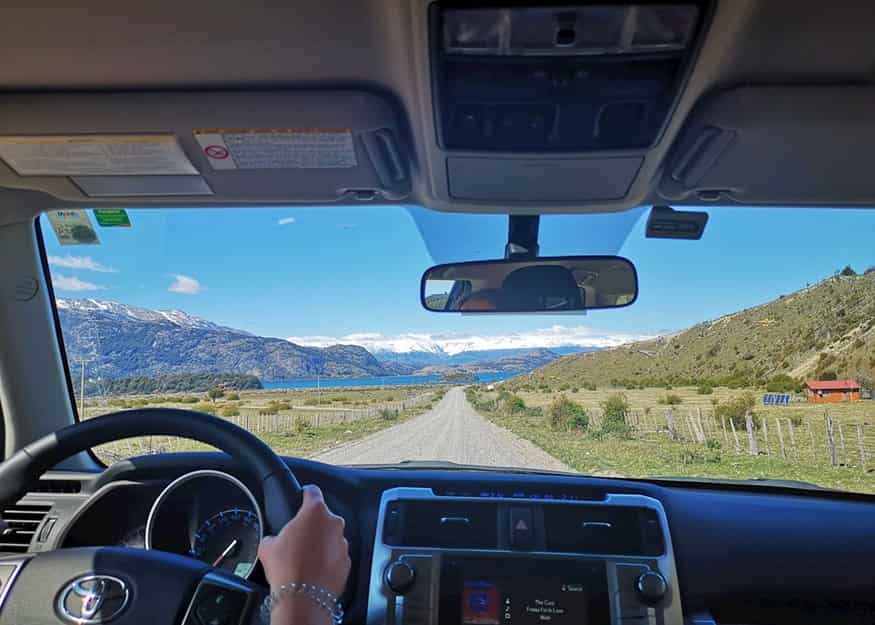
The Carretera Austral is Chile’s most spectacular and most demanding driving road. Approximately 60% of the 1,240-kilometer route is unpaved gravel, with sections ranging from well-graded gravel to rough, potholed terrain that tests vehicles and drivers alike. River crossings by vehicle ferry (barcaza) are required at multiple points — book ferry slots in advance for January and February. A 4×4 pickup truck is strongly recommended for the full Carretera Austral. Fuel stations become increasingly rare south of Coyhaique — fill up at every opportunity and carry a spare fuel canister for the most remote sections.
Patagonian weather is legendarily volatile. Conditions can shift from sunshine to blinding rain and extreme wind in minutes. The wind alone — regularly exceeding 100 km/h in open steppe sections — can physically push a vehicle across lanes. Reduce speed dramatically in high wind conditions and be alert to wind-induced steering correction requirements.
Night Driving: Approach with Caution
Experienced drivers in Chile consistently advise avoiding driving at night on rural and remote roads. Several factors make nighttime rural driving genuinely risky:
- Oncoming headlights pointed too high, regularly blinding other drivers on two-lane roads
- Livestock and animals on the road — particularly in rural and agricultural zones, where cattle, horses, and dogs frequently stray onto the carriageway after dark
- Unmarked road hazards and potholes invisible at night on unlit rural roads
- Limited roadside assistance — if you break down at night on a remote route, help may be hours away
In cities, nighttime driving is generally safe on well-lit main roads but carries the standard urban risks of reduced visibility and occasional opportunistic crime. Never leave valuables visible in a parked car, especially overnight.
Safety on the Road: Practical Tips for Tourists
Beyond the legal requirements, experienced Chile drivers offer consistent practical advice:
- Download offline maps before departure — Google Maps and Waze work well in populated areas, but coverage deteriorates on remote routes. Apps like Maps.me provide offline functionality for areas without mobile signal
- Carry cash for tolls — while major toll roads use electronic systems, many secondary toll stations (peajes) only accept cash in Chilean pesos. Most individual tolls cost CLP $1,000–$5,000
- Check weather forecasts daily in Patagonia — and be genuinely prepared to delay a day if conditions are dangerous. No viewpoint is worth the risk of driving in a Patagonian windstorm on gravel
- Always carry your documents — Chilean law requires drivers to carry their valid driver’s license, passport (for foreign nationals), vehicle registration (padrón), and insurance documents at all times. Carabineros conduct roadside checks and will request all four
- Obtain an International Driving Permit (IDP) before traveling — while not legally required for most nationalities, Carabineros often prefer Spanish-language documentation, and an IDP translates your home license into a universally recognized format that avoids misunderstandings during police stops
- Plan fuel stops on remote routes — particularly on the Carretera Austral and in the Atacama, where distances between fuel stations can exceed 200 kilometers
- Slow down at unmarked intersections and hill crests — Chilean road culture involves approaching these points cautiously, and visibility can be severely limited on mountain roads
What to Do If Stopped by Carabineros
Chile’s Carabineros are a professional, uniformed national police force with a generally positive reputation for treating foreign tourists fairly and respectfully. If you are stopped at a roadside check or traffic stop:
- Pull over promptly and safely to the right
- Turn off the engine and keep your hands visible
- Present your driver’s license, passport, vehicle registration, and insurance documents when requested
- Remain calm and polite — most routine stops are brief document checks
- Do not offer cash to a Carabinero under any circumstances — attempted bribery is a serious criminal offense in Chile and will dramatically worsen any situation
If you receive a traffic fine (infracción), the officer will typically issue a written citation. Fines must be paid officially — rental companies will charge the amount to your deposit if the fine is sent to them after your return.
Final Verdict: Safe to Drive, With Preparation
Driving in Chile is genuinely safe and deeply rewarding for tourists who prepare properly. The country’s roads outside major cities are well-maintained, traffic volumes on most routes are manageable, and the scenery en route is among the most spectacular anywhere on Earth. The risks that do exist — urban traffic complexity in Santiago, extreme conditions on the Carretera Austral, altitude on Atacama routes, and Patagonian weather — are all manageable with the right vehicle, the right insurance, and the right knowledge.
Study the rules before you drive, respect the road conditions you encounter, and Chile will reward you with a freedom of exploration that no bus or tour can replicate.