Chile is one of the world’s great road trip destinations. From the lunar landscapes of the Atacama Desert in the north to the glacier-carved fjords of Patagonia in the south, the country’s extraordinary geographic diversity is best experienced at your own pace — behind the wheel, with the freedom to stop wherever the landscape demands it. But renting a car in Chile comes with its own set of rules, costs, and potential pitfalls that can catch unprepared travelers off guard. This complete guide covers everything you need to know about car rental in Chile, from daily rates and insurance options to driving tips and the road conditions you’ll actually encounter.
Why Rent a Car in Chile?
Public transport in Chile is reasonably good between major cities, but it becomes progressively limited — and ultimately inadequate — the moment you want to explore beyond the main tourist corridors. The legendary Carretera Austral in Patagonia, the wine valleys of Colchagua and Maipo, the remote hot springs of the Lake District, and the back roads between Atacama’s most spectacular salt flats all require either an expensive private tour or your own vehicle to access fully.
Renting a car in Chile gives you flexibility that no bus schedule can replicate. It allows you to arrive at Valle de la Luna before the crowds, catch a Patagonian sunrise at an empty viewpoint, or detour down an unmarked gravel road simply because something glittered in the distance. For travelers spending more than a few days outside of Santiago, it is often the most cost-effective and rewarding option.
Car Rental Prices in Chile
Rental prices in Chile vary significantly by vehicle category, season, rental company, and pickup location. As a general benchmark:
- Economy/compact cars (e.g., Chevrolet Spark, Toyota Yaris): from USD $25–$45 per day
- Intermediate sedans (e.g., Toyota Corolla, Hyundai Elantra): from USD $40–$70 per day
- SUVs and crossovers (e.g., Toyota RAV4, Hyundai Tucson): from USD $60–$100 per day
- 4×4 pickup trucks (e.g., Toyota Hilux, Ford Ranger): from USD $80–$140 per day — essential for the Carretera Austral and Atacama backcountry roads
Peak season surcharges apply during January, February, and major Chilean holidays, when demand surges and prices can increase by 30–50% over base rates. Booking well in advance — ideally 4–8 weeks ahead — is strongly recommended during these periods.
Most reputable rental companies include unlimited mileage, VAT (IVA at 19%), and basic insurance in their advertised rates, but always verify the exact inclusions before confirming a booking. Airport pickup locations typically carry a surcharge over downtown office pickups.
Major international brands operating in Chile include Hertz, Avis, Europcar, Sixt, and Budget, all present at Santiago’s Arturo Merino Benítez International Airport. Strong local operators like Chilean Rent-A-Car and Final Rentals offer competitive rates and, in many cases, more flexible policies for cross-regional travel and off-road use.
Understanding Car Rental Insurance in Chile
Insurance is the single most important — and most commonly misunderstood — aspect of renting a car in Chile. Getting it wrong can expose you to costs of thousands of dollars. Here is a clear breakdown of every layer of coverage you need to understand.
SOAP — Mandatory Personal Injury Insurance
Every vehicle legally on Chilean roads must carry SOAP (Seguro Obligatorio de Accidentes Personales) — a mandatory third-party personal injury policy required by Chilean law. Rental companies are legally obligated to include this in every rental. However, SOAP coverage is extremely limited: it covers medical expenses, disability, and death for people involved in an accident, but provides absolutely no coverage for damage to the rental car, other vehicles, or any property. Think of it as a legal baseline, not actual protection.
CDW — Collision Damage Waiver
The CDW (Collision Damage Waiver) covers damage to or theft of the rental vehicle above a deductible (franquicia). Most Chilean rental companies include a standard CDW in their base rate — but crucially, this comes with a significant deductible that you remain responsible for in the event of damage.
At Chilean Rent-A-Car, for example, standard CDW deductibles vary by vehicle category and can reach several hundred thousand Chilean pesos per incident. The CDW does not automatically cover tires, windshield glass, the undercarriage, roof damage, or single-vehicle accidents on unpaved roads — exclusions that are particularly relevant on Chile’s many gravel roads.
DAT — Third-Party Liability Insurance
DAT (Daños a Terceros) covers damage you cause to other vehicles, property, or people beyond the SOAP limits. Standard DAT coverage is typically included in Chilean rentals alongside CDW, but the liability ceiling is often set at a relatively low UF value. Supplementary liability options (SLP, SLP+) are available to increase this ceiling significantly for travelers concerned about worst-case scenarios.
Insurance Upgrade Options: Which One Do You Need?
Chilean rental companies typically offer a tiered upgrade structure above the standard CDW/DAT package. Using Chilean Rent-A-Car’s model as a representative example:
| Coverage Level | What It Adds | Best For |
|---|---|---|
| Standard (included) | CDW + DAT with deductible | Short urban rentals, low-risk driving |
| Assistance | Adds roadside assistance (AR) | Any rental outside major cities |
| Plus | Adds deductible reduction (RDD) + enhanced liability (SLP) | Most travelers on moderate roads |
| Premium | Further deductible reduction (RDD+) + higher liability (SLP+) | Long-distance, mixed road surfaces |
| Super Protection | Zero deductible (EDD) + maximum liability (SLP++) + accessories coverage (SACA) | Carretera Austral, Atacama backcountry, Patagonia |
The Super Protection (or equivalent zero-deductible package) costs $25–$40+ USD per day added to your rental rate but eliminates your financial exposure in the event of damage. For most travelers venturing outside Santiago onto gravel roads, volcanic terrain, or remote Patagonian routes, this level of coverage is a prudent investment.
Third-Party Insurance vs. Rental Company Super Cover
An increasingly popular alternative to buying the rental company’s super cover is purchasing a standalone third-party insurance policy (from providers like RentalCover or QEEQ) before your trip. These policies typically cost $7–$15 USD per day — substantially less than the rental company’s zero-deductible upgrade — and often provide broader coverage, including tires, glass, undercarriage, roof, key loss, and climate-related damage like hail, floods, and sand.
The critical tradeoff: third-party policies operate on a reimbursement model — you pay for damages out of pocket first, then claim the money back. The rental company will also place a large security deposit hold of $3,000–$5,000+ USD on your credit card to cover the deductible you remain responsible for under the rental agreement. Your card must have sufficient available credit to accommodate this hold for the duration of the rental.
The bottom line: For most travelers on a standard road trip, the rental company’s Plus or Premium package is the most practical middle ground. For the Carretera Austral, Atacama, or Patagonia backcountry, opt for Super Protection or a comprehensive third-party policy.
Driver Requirements
To rent a car in Chile, you will need:
- A valid driver’s license from your home country — international driver’s permits are widely accepted but not legally required for most nationalities
- Minimum age of 21 years at most major rental companies; some companies charge higher rates or require additional fees for drivers under 25
- A valid credit card in the renter’s name for the security deposit hold — debit cards are generally not accepted for the guarantee
- A valid passport for foreign nationals
Drivers under 23 at Chilean Rent-A-Car face double deductibles on standard coverage plans, and some coverage upgrade options may be unavailable to them. Always verify age-related restrictions before booking.
Road Conditions & Driving Tips
Chile’s roads range from excellent to genuinely challenging, and knowing what to expect is essential for safe driving:
Santiago and Major Highways
Chile’s Ruta 5 — the Pan-American Highway — runs north to south through the country’s populated heartland and is a well-maintained, multi-lane toll road between Santiago and La Serena or Santiago and Puerto Montt. Electronic tolls are in operation on this route; most rental companies provide an e-toll device (TAG) for an additional daily fee, which is strongly recommended to avoid manual toll queues and potential fines.
Northern Chile (Atacama Region)
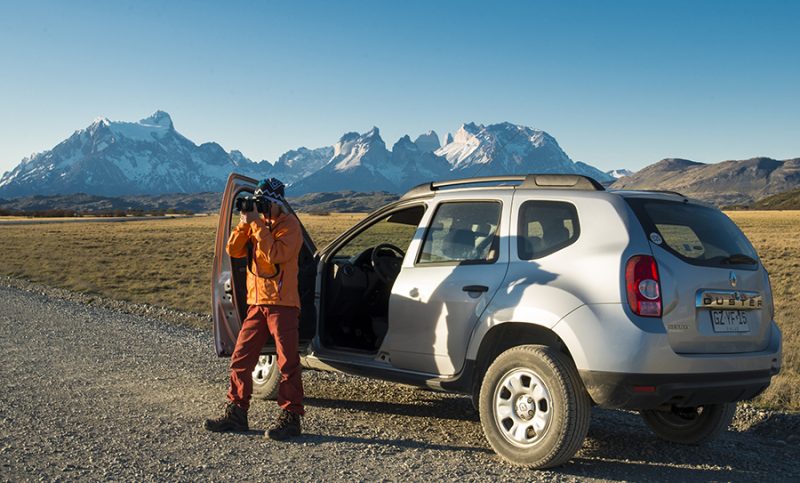
Roads between San Pedro de Atacama’s main attractions are a mix of paved and unpaved surfaces. The high-altitude routes to El Tatio, Piedras Rojas, and the Bolivian border are unpaved gravel and require a vehicle with good ground clearance. A standard SUV is sufficient for most Atacama routes; a true 4×4 is necessary only for the most remote backcountry access. Verify your rental agreement explicitly permits off-road use — many standard agreements exclude unpaved road driving, which could void your coverage.
Carretera Austral (Patagonia)
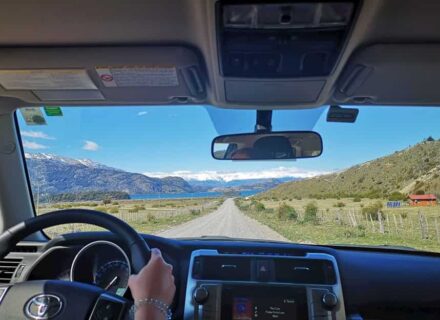
The Carretera Austral is Chile’s most spectacular and demanding driving road. Running 1,240 kilometers south from Puerto Montt through Patagonia’s roadless wilderness, roughly 60% of the route is unpaved gravel in varying conditions. A 4×4 pickup truck (Toyota Hilux or equivalent) is strongly recommended for the full route. River crossings by vehicle ferry (barcaza) are required at several points — booking ferry slots in advance is essential during January and February when demand peaks. Fuel stations are sparse; carry a full tank and consider a spare fuel canister for the most remote sections.
General Driving Rules
- Chile drives on the right-hand side of the road
- Speed limits: 120 km/h on highways, 100 km/h on secondary roads, 60 km/h in urban areas (lower in school zones)
- Zero tolerance for alcohol — Chile’s legal blood alcohol limit is 0.03 g/dL (effectively zero for practical purposes)
- Headlights on at all times — Chilean law requires daytime running lights on all highways regardless of conditions
- Chilean drivers in Santiago can be aggressive and lane discipline is loose — exercise caution in urban traffic
- On mountain roads, the vehicle going uphill has the right of way over descending vehicles
Top Tips for Renting a Car in Chile
A few final pieces of advice will save you significant time, money, and stress:
- Photograph everything before you drive away — document every existing scratch, dent, and paint chip on the vehicle with timestamped photos and video before leaving the rental lot, and have the agent sign off on a written damage report
- Read the fine print on road restrictions — many rental agreements prohibit driving into Argentina or Bolivia, or restrict the vehicle from unpaved roads; violating these terms can void all insurance coverage
- Book online in advance — walk-in rates at Chilean rental desks are consistently higher than pre-booked online prices, sometimes by 20–30%
- Consider a local operator for the Carretera Austral — local companies familiar with the route often have better-maintained 4×4 fleets, more flexible pickup/drop-off policies, and more practical advice than international chains
- Fuel is not included — Chile’s fuel prices are moderate by South American standards but significant on long drives; return the car with a full tank to avoid rental company refueling fees, which are markedly inflated above pump prices
- Check your credit card’s rental car benefits — some premium Visa, Mastercard, and Amex cards include primary rental car coverage that may reduce or eliminate the need for additional insurance; verify the terms apply to Chile specifically before relying on them
Chile rewards those who explore it with genuine curiosity and adequate preparation. Rent the right vehicle, understand your insurance coverage completely, and the country’s extraordinary landscapes — from the bone-dry Atacama to the ice-carved channels of Patagonia — will unfold before you at exactly the pace you choose.